Summary of the Journal’s Contents
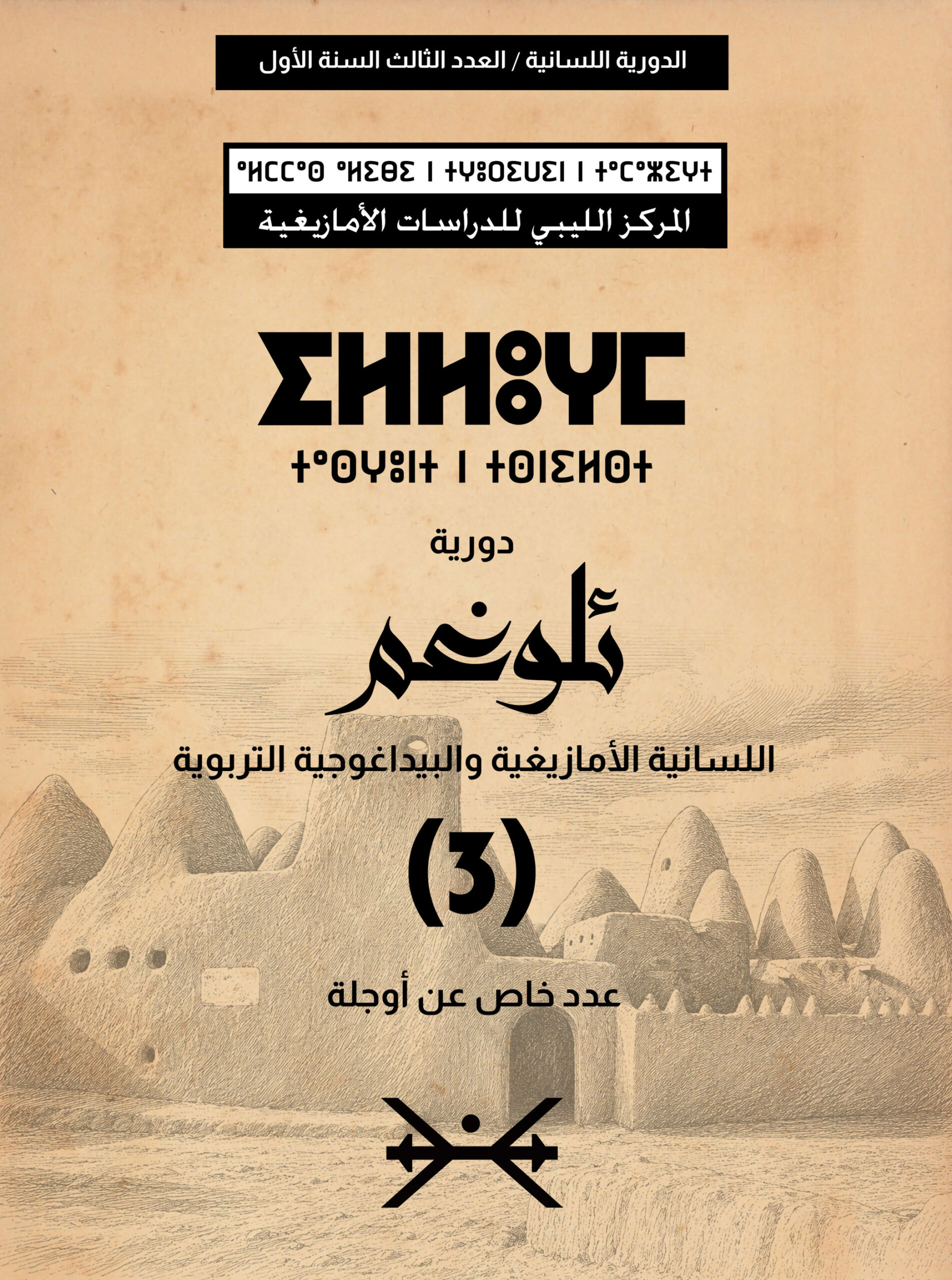
The third issue of Illughm presents a special scholarly dossier devoted to the Amazigh variety of the Awjila Oasis in eastern Libya, examining it from complementary linguistic, social, and historical perspectives. It explores the process of language shift within the oasis, the changing distribution of functions between Awjili and Arabic, and the relationship of these developments to local identity, social structure, kinship networks, and the economy. This discussion draws on a critical sociolinguistic reading of John Paul Mason’s dissertation.
A substantial part of the issue is devoted to the internal structure of Awjili through analyses of its phonological, morphological, and lexical features. It also situates Awjili within the Eastern Amazigh varieties by comparing it with Siwi, Ghadames, and the varieties of the Nafusa Mountains. Furthermore, its vocabulary is examined using an expanded Swadesh list and compared with the Yefren variety to identify shared roots, sound correspondences, and the extent of lexical borrowing, thereby highlighting the patterns of retention and innovation that distinguish Awjili.
The issue also reviews the history of linguistic research on Awjili Amazigh, from the earliest documentary writings to contemporary scholarship. It includes translations and critical editions of foundational texts and studies by Fernando Zanon, Umberto Paradisi, André Basset, and Vermondo Brugnatelli, together with historical Awjili texts accompanied by translations. In this way, the issue brings together theoretical analysis, field documentation, and historical comparison, providing a valuable reference that contributes to the preservation of Awjili and advances research into Libya’s Amazigh linguistic heritage.