ⴰⴳⵣⵓⵍ ⵏ ⵓⴳⴱⵓⵔ ⵏ ⵜⵙⵖⵓⵏⵜ
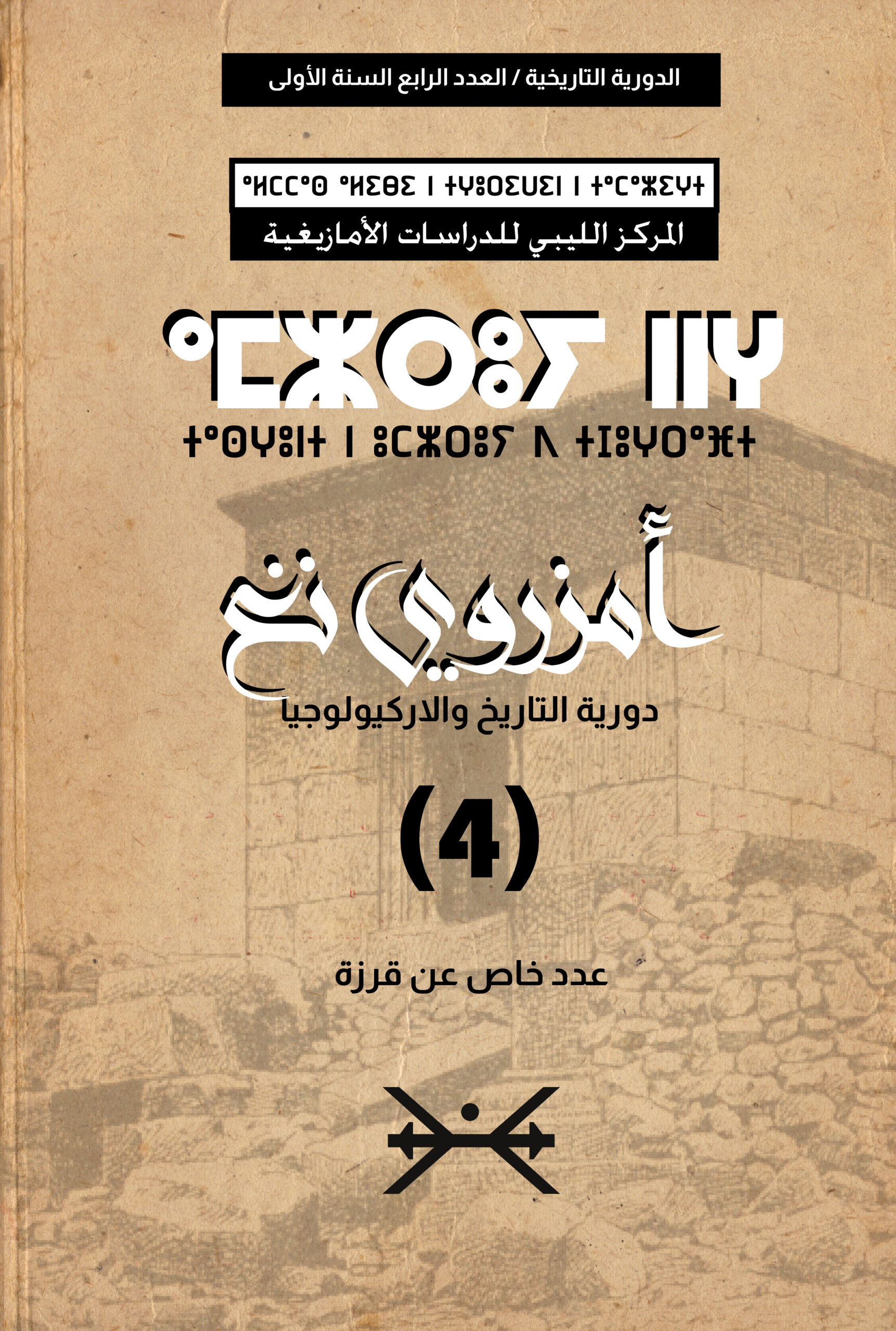
The fourth issue of the journal Amezruy Nnegh / Our History is dedicated to the archaeological town of Ghirza, one of the most prominent urban centers of the Libyan pre-desert region in antiquity. Its remains stand as vital testimonies to the history of local Libyan communities—their ways of life, agricultural systems, arts, beliefs, and connections with the wider Mediterranean world. This issue seeks to bring together key historical and archaeological studies on Ghirza and make a selection of research originally published in foreign languages accessible to the Libyan reader.
The issue opens with a critical historical and bibliographical study tracing references to Ghirza across classical and Islamic sources, travelers’ accounts, archaeological mission reports, and modern scholarship, while examining the challenges of identifying the site, dating it, and interpreting its material evidence. This is followed by an analytical review of Olwen Brogan and David Smith’s monograph on Ghirza, which addresses settlement patterns, architecture, agriculture, resource management, and archaeological finds, highlighting the site's importance for studying social and economic life in ancient Libya.
Furthermore, the issue features a collection of translated studies on relief sculpture and funerary architecture, including Maria Floriani Squarciapino’s study on the reliefs of Ghirza and the ornamentation of its mausolea, alongside Giulia Nikolaus’s study situating the tombs of Ghirza within the broader context of funerary architecture in Tripolitania. It also presents research on the Libyco-Berber inscriptions discovered at the site and the questions they raise regarding language, script, and identity.
The relationship between art and power is explored through David Mattingly’s study of the symbols and iconography carved onto Ghirza’s tombs, complemented by Khaled Al-Haddar’s examination of the sculptures removed from the town and currently preserved in the Istanbul Archaeological Museums. The issue concludes with a study by Lucy Audley-Miller on dress and personal adornment in the funerary sculptures, analyzing their social and cultural significance and what they reveal about status, identity, and the transformations experienced by the community of Ghirza.
By combining historical inquiry, archaeological study, and the analysis of inscriptions, art, and dress, this issue provides the Libyan reader with diverse scholarly material on the town of Ghirza. In doing so, it contributes to restoring due recognition to a pivotal site for understanding the history of ancient Libyan civilization, while paving the way for further research, documentation, and the preservation of this heritage.